
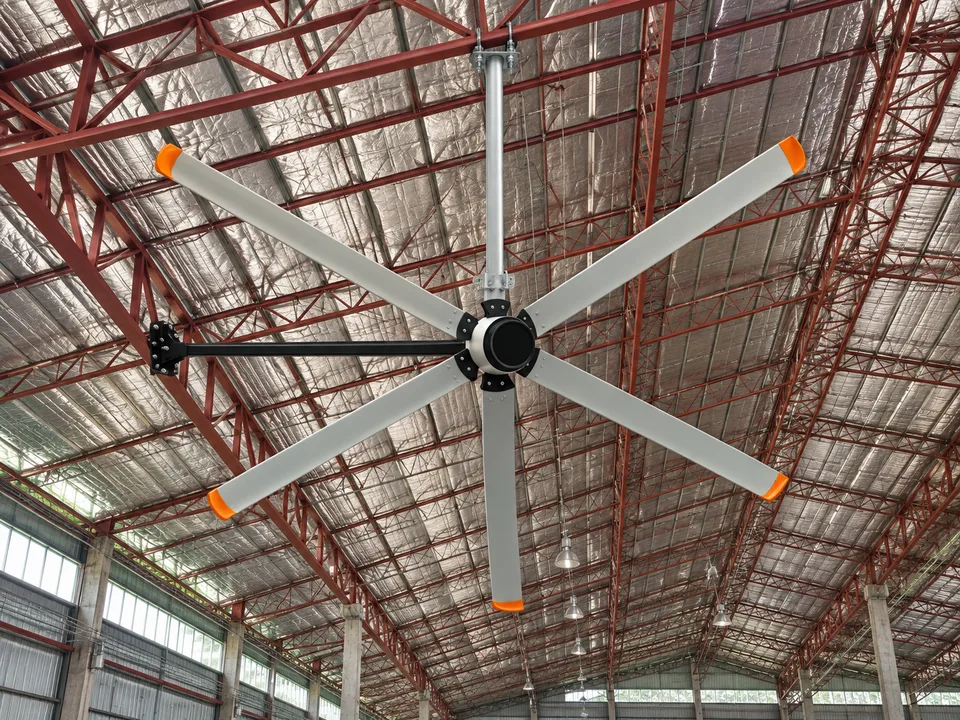
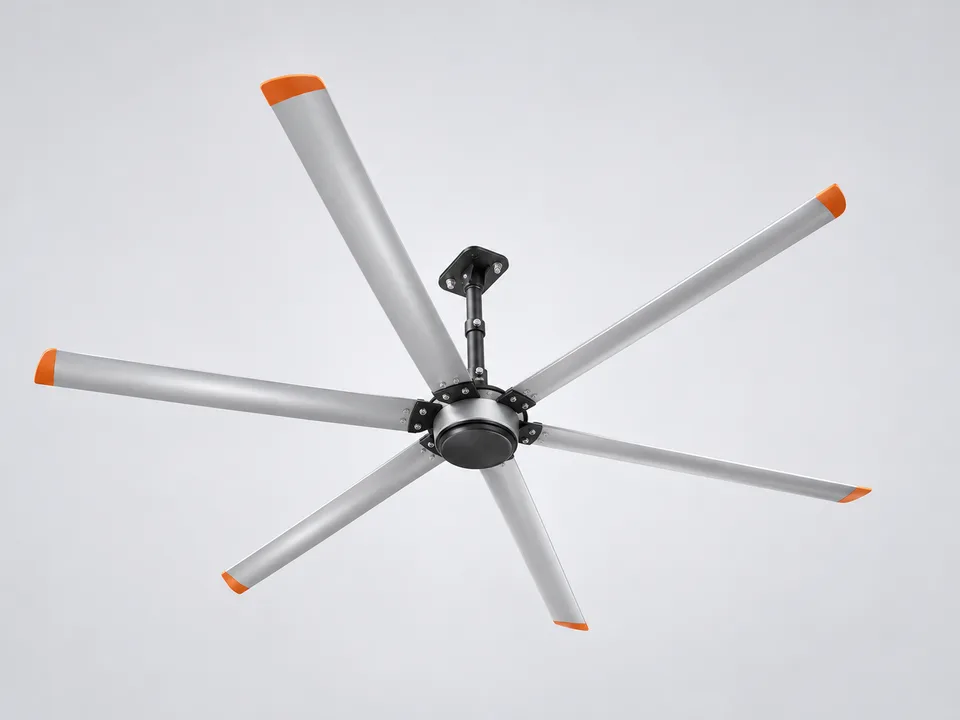
HVLS Ceiling Fans in Saudi Arabia

Ten floor fans, ten cables across the aisle, and the far corner is still hot. Cooling a big hall with AC alone costs a fortune, and floor fans get in the way of people and forklifts. It is fair to want the whole floor comfortable without either problem. One big fan on the ceiling, turning slowly, can do the work of many small ones.

We supply HVLS ceiling fans from 2.5 to 7.3 m across for warehouses, factories, mosques, gyms and showrooms, and we have supplied them to all of these in the Kingdom. Send us your floor plan and roof height on WhatsApp, and we will tell you how many fans you need and where they go. How big is your hall?

Large HVLS ceiling fan installed in a warehouse
  • 20+ years in Saudi Arabia
  • 2 years warranty
  • 1000+ Satisfied Clients
  • Fast Delivery Across KSA

What Is an HVLS Fan?

HVLS stands for high volume, low speed. These fans have long blades, up to 7.3 m across, that turn slowly, between 56 and 120 times a minute. The blades push a wide column of air down to the floor, where it spreads out sideways across the whole area. Because the fan is so large, it moves a lot of air with little power and runs quietly.

Our fans use a gearless permanent magnet motor, so there is no gearbox to leak oil or wear out. The blades are a light polymer composite with an airfoil shape, like an aircraft wing. The 7.3 m model weighs only 83.6 kg for its main body, which keeps the load on the roof steel low. The motor carries a 10 year warranty.

What Is an HVLS Fan?

How Much Cooler Will It Feel?

A big fan does not lower the air temperature, but it makes people feel cooler. A steady breeze dries sweat faster, and fan makers report that it can make a hot room feel about 4 to 6 °C cooler. In a UC Berkeley study in hot steel plants, moving air cut workers' discomfort as much as a 5 °C drop in temperature. For this effect, the air should reach people at about 1 m/s, which is the speed our optimum area figures are based on.

In a hall with AC, the fan mixes the cool air evenly, so you can set the thermostat a little higher and still feel comfortable. It also breaks up the hot layer of air that collects under the roof. It only moves air around the room, so hot air still needs a roof or wall exhaust fan to leave the building.Roof exhaust fans

Industrial Range: 4.0 to 7.3 m

Each industrial ceiling fan in this range is built for tall warehouses, factories and logistics halls. The biggest model moves 17,800 m³ of air a minute on just 1,250 W, which is about 14 m³ a minute for each watt. The optimum area column shows the floor that gets air at 1 m/s or more, and the coverage column shows the wider area that still feels a breeze.

ModelDiameterSpeedAirflowPowerOptimum areaCoverage
ICF73H7.3 m (24 ft)56 rpm17,800 m³/min1,250 W840 m²1,375 m²
ICF65H6.5 m (21 ft)66 rpm14,900 m³/min1,100 W650 m²1,100 m²
ICF55H5.5 m (18 ft)80 rpm12,000 m³/min850 W450 m²800 m²
ICF49H4.9 m (16 ft)85 rpm10,500 m³/min720 W360 m²700 m²
ICF43H4.3 m (14 ft)90 rpm8,500 m³/min480 W250 m²610 m²
ICF40H4.0 m (13 ft)95 rpm7,500 m³/min420 W220 m²550 m²

Commercial Range: 2.5 to 4.2 m

The commercial range has a cleaner look for spaces where people see the fan, such as gyms, car showrooms, supermarkets, restaurants and airport halls. These models fit lower ceilings and smaller rooms. The 3 m model covers about 330 m² on only 260 W.

ModelDiameterSpeedAirflowPowerOptimum areaCoverage
ICF42E4.2 m (13.8 ft)70 rpm6,750 m³/min340 W185 m²465 m²
ICF36E3.6 m (11.8 ft)85 rpm5,850 m³/min325 W165 m²425 m²
ICF30E3.0 m (9.8 ft)110 rpm5,250 m³/min260 W115 m²330 m²
ICF25E2.5 m (8.2 ft)120 rpm3,600 m³/min150 W56 m²225 m²

How Many Fans Do You Need?

Start with the floor area where people work, not the whole building. Divide it by the optimum area of the fan size that fits your height. For example, a 5,000 m² warehouse with a tall roof needs about 5,000 ÷ 840 = 6 of the 7.3 m model. Racks, mezzanines and walls block air, so a hall with tall racking often needs more, smaller fans placed over the aisles.

As a guide, fan makers space large fans about 2.5 to 4 times their diameter apart, so 7.3 m fans sit roughly 18 to 29 m apart. Larger fans push air further down long aisles, while smaller fans suit separate work zones. Send us the floor plan with racks and machines marked, and we will suggest a layout.CFM calculator

Mounting Height and Clearances

Most makers ask for the blades to be at least 3 m (10 ft) above the floor, and at least a quarter of the fan diameter below the roof, so air can feed in from above. For a 7.3 m fan, that means about 1.8 m between the blades and the roof. Large fans work best when hung about 6 to 9 m above the floor. Keep the blades at least 0.6 m from lights, ducts and beams, and avoid hanging a fan right under lights or skylights, because the turning blades cause a flicker.

The fan hangs from the roof steel, so your structural engineer should check the beam and fixing point before you order. Our fans are light for their size, which helps on older sheds. Send us the clear height to the lowest beam, not just the roof height.

HVLS Fans and Fire Sprinklers

Big fans can push away the heat that sets off sprinklers, so the US sprinkler standard NFPA 13 has four rules for them. The fan must be no more than 7.3 m (24 ft) across, and it should sit roughly in the middle of four sprinkler heads. The blades must be at least 0.9 m (36 inches) below the sprinkler deflectors. The fan must also shut down as soon as sprinkler water starts to flow, through the building's fire alarm system.

These rules come from fire tests. FM Global found that a fan left running weakened the sprinklers, while a fan that stopped within about 90 seconds let them work properly. Our largest model is exactly 7.3 m, so every size in our range is within the size limit. Share the sprinkler layout with your fire contractor, who wires the shutdown to the fire alarm panel.

Where HVLS Fans Work Best

Warehouses and Factories

Warehouses and Factories

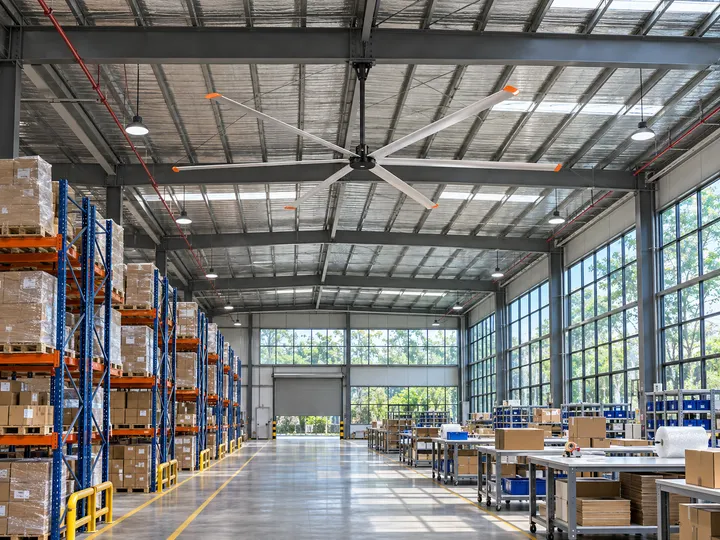
Warehouses in Riyadh's industrial cities, Dammam and Jeddah are often too big and too tall to cool with AC. Big fans keep pickers, packers and forklift drivers cooler without cables or stands on the floor. The industrial range is designed for car and parts plants, metal workshops, logistics hubs and rail depots. A few ceiling fans also replace many floor fans, which frees up aisle space.Portable drum fans

Mosques and Prayer Halls

Mosques and Prayer Halls

Large prayer halls with high ceilings often have AC that leaves the back rows warm on a busy Jumuah. A slow ceiling fan spreads the cool air evenly from the mihrab to the back wall. Because the blades turn slowly, they make little noise during prayer. We have supplied these fans to mosques in the Kingdom.

Gyms, Courts and Event Halls

Gyms, Courts and Event Halls

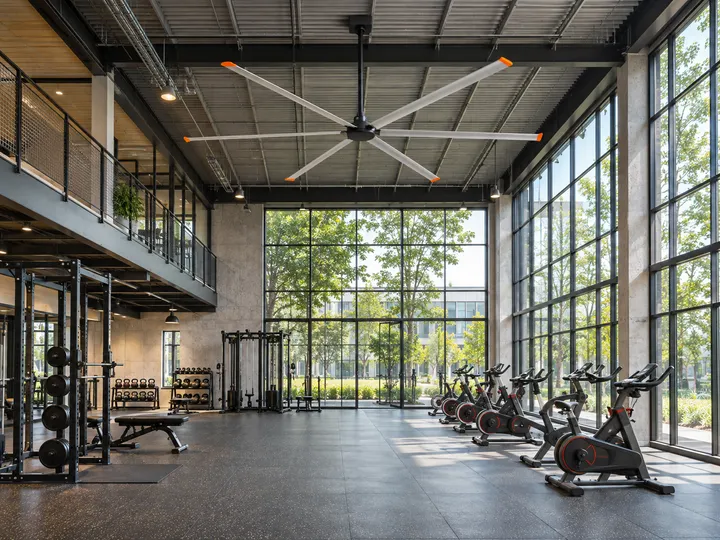
Gyms, padel and football courts, wedding halls and event tents fill up with warm, still air when they are busy. The commercial range keeps the air moving over people without the noise of many small fans. In semi open sheds, the IP65 motor keeps dust out, but ask us to check the site first if it faces strong wind.

Get a Quote for Your Hall

Send us your floor plan, the clear height to the lowest beam and what the space is used for on WhatsApp. Mark the areas where people work and any racks, cranes or mezzanines. We will reply with the fan size, the number of fans and a suggested layout. We deliver from Riyadh across the Kingdom, including Jeddah, Dammam, Jubail and Makkah. Which hall do you want to cool?

See all prices in our exhaust fan price guide

Quotation Request

Tell us what you need

Tell us what you need. We’ll help you choose a suitable fan.

Add details if you know them (optional)
WhatsApp Instead

Frequently Asked Questions

Can an HVLS fan replace an exhaust fan?

No. It moves air around inside the building but does not push it out. Hot air and fumes still need a roof or wall exhaust fan, and the two work well together.

Can I use these fans with air conditioning?

Yes, and they help. The fan spreads the cool air evenly and stops it from pooling near the floor or around the units. Many sites set the AC a little warmer and still feel comfortable, which saves power.

How much power does a big ceiling fan use?

Very little for its size: 150 W for the 2.5 m model up to 1,250 W for the 7.3 m model. Running the largest fan for 10 hours uses about 12.5 kWh. That is far less than cooling the same floor with AC alone.

How high must my roof be?

The blades should be at least 3 m above the floor, with about a quarter of the fan diameter clear above them. So a 3 m fan needs a clear height of about 4 m or more, and a 7.3 m fan works best with 6 m or more. Send us the height to the lowest beam, and we will pick the right size.

How long does the motor last?

The permanent magnet motor has no gearbox and no brushes, so there is little to wear out. It is rated for 130 °C, sealed to IP65 against dust, and carries a 10 year warranty. Keep the blades clean and check the fixings once a year, and the fan should run for many years.