Daily Fume Control
In normal use, CO and NO2 sensors watch the air. When cars come in and the fumes rise, the fans speed up. When the car park is quiet, they slow down or stop, which saves power through the long night hours.
An underground car park fills up with exhaust fumes every time the cars line up at the barrier. Drivers smell it, the CO alarm goes off, and big ducts eat into the ceiling height and the parking bays. In a fire, the same space fills with smoke in minutes. These fans solve both problems without a maze of ducts.
We supply jet fans for basement car parks in malls, towers, hospitals and housing projects across the Kingdom. Send us your consultant's fan schedule on WhatsApp, and we will match every line with a clear price and datasheets. How many levels does your car park have?
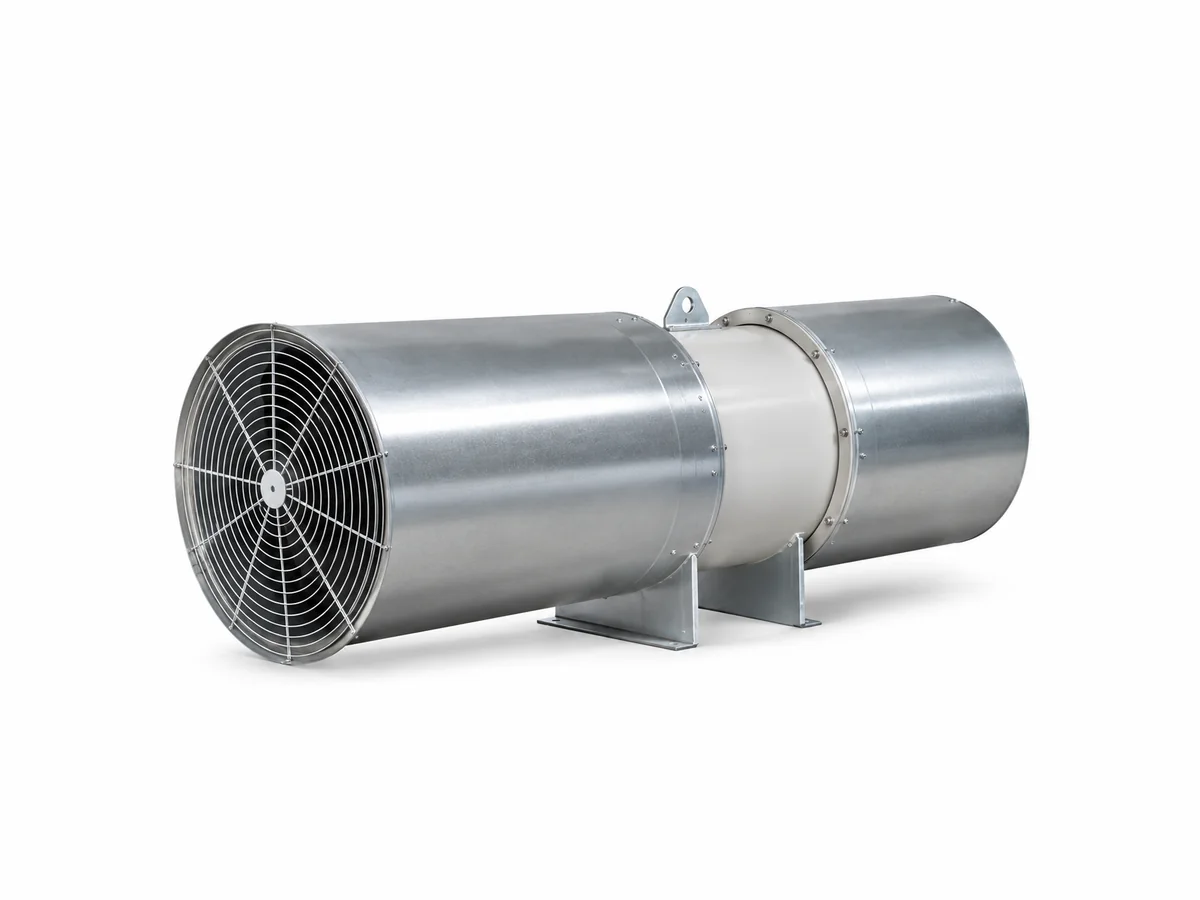
A jet fan is a short, powerful fan that hangs under the car park ceiling. It does not suck air out of the building by itself. Instead, it blows a fast stream of air that drags the air around it along, like a push. A row of these fans moves the dirty air across the whole floor toward the main exhaust fans, which then throw it outside.
Because the fans push the air, the car park needs little or no ductwork. That keeps the ceiling clear, gives more headroom for cars and makes the space brighter and easier to clean. You may also hear them called impulse fans or induction fans.
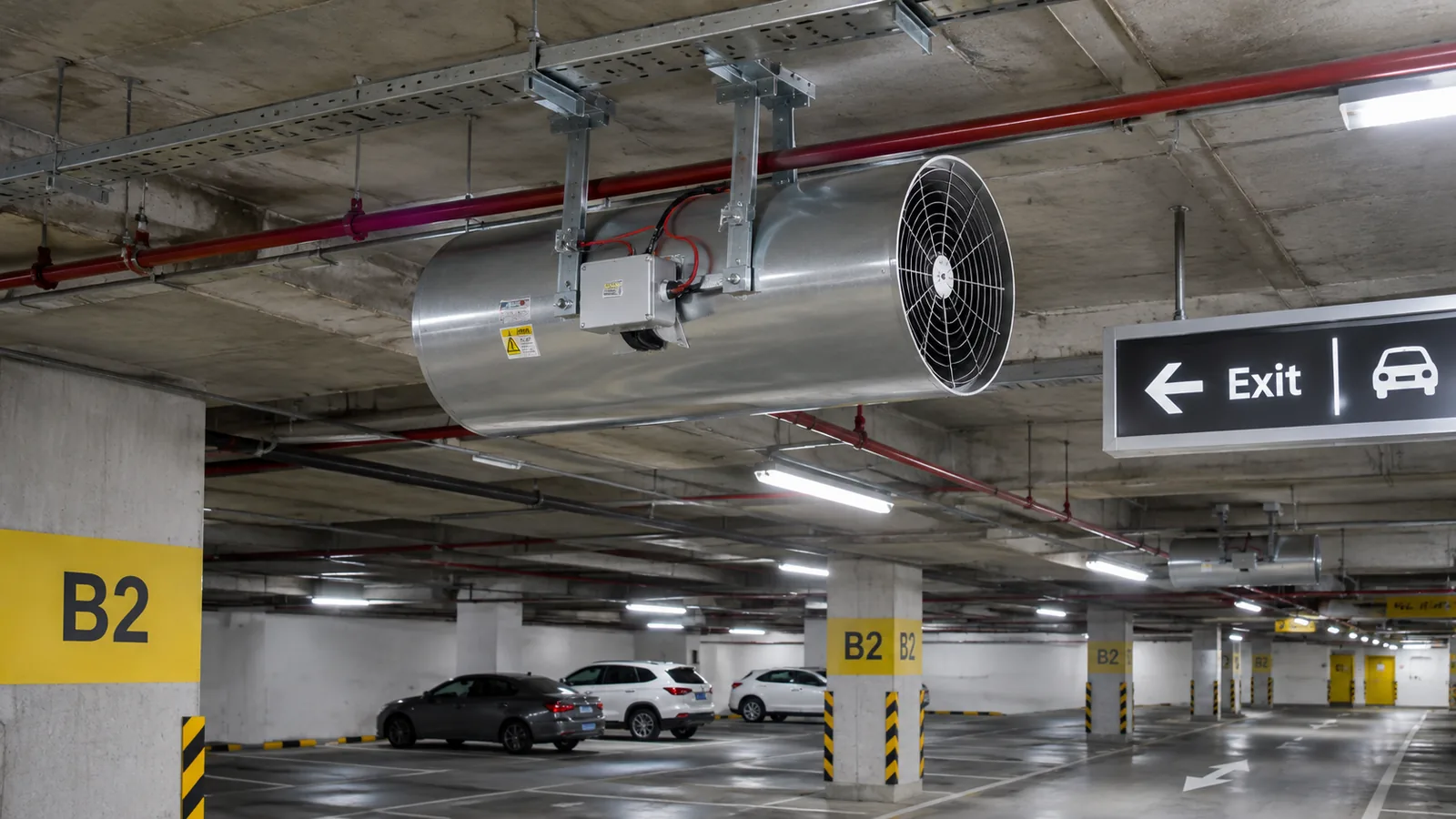
In normal use, CO and NO2 sensors watch the air. When cars come in and the fumes rise, the fans speed up. When the car park is quiet, they slow down or stop, which saves power through the long night hours.
When the fire alarm starts, the fans switch to full power. They push the smoke toward the exhaust points, so the exits stay clear and Civil Defense teams can reach the fire. For this job the fans must be rated to run in hot smoke, often 300°C or 400°C.Smoke extraction fans
In Saudi Arabia, the car park ventilation and smoke system is designed by the project consultant under the Saudi Building Code. The fire side follows SBC 801 and needs Civil Defense approval, so we match the fans to the approved design.
For daily air, the International Mechanical Code, which the Saudi Mechanical Code (SBC 501) is based on, asks for at least 0.75 CFM for each square foot of floor when the system runs at full power. That is about 13.7 m³/h for each square metre. Systems with CO and NO2 sensors may slow down when the air is clean, but not below a small standby rate.
Many designs also use 6 air changes per hour in normal use and 10 in fire mode. Your consultant decides which method applies, often with a computer smoke study for large car parks.
A one way fan pushes air in one direction only. A reversible fan can push both ways, so the system can move smoke away from whichever side the fire is on.
They are sized by thrust, the force of the air stream, in newtons. Common sizes are 50, 75 and 100 N. More thrust covers more floor, so you need fewer fans.
Some car parks have low beams or ceilings. Low profile units are shorter in height and fit between the beams, so they do not block the cars.
For smoke clearing, the fan and motor must pass a heat test to EN 12101-3, such as F300 or F400. The class must match the one in your fan schedule.
A basement in Riyadh is 50 m long, 40 m wide and 3 m high. That is 2,000 m² of floor and 6,000 m³ of air.
| Method | Airflow needed |
|---|---|
| 0.75 CFM per sq ft of floor | about 27,400 m³/h |
| 6 air changes per hour (normal use) | 36,000 m³/h |
| 10 air changes per hour (fire mode) | 60,000 m³/h |
The main exhaust fans are sized for the airflow. The push fans are then placed so that no corner is left with still air, and their number depends on their thrust and the layout of ramps and columns. This is why we always work from the consultant's drawing. Want to check the numbers for your car park first?CFM calculator
To quote the right fan, send us the fan schedule or this short list:
Number of fans, and one way or reversible
Thrust in newtons, or the airflow and throw needed
Fire class, such as F300 or F400, and the running time
Power supply, normally 380 V three phase, 60 Hz
Mounting height and the space between beams
Single speed or two speed, and the control panel if needed
We also supply the main exhaust and supply fans for the same car park, so one quote can cover the whole system.Inline duct fans
The price depends on the thrust, the fire class, one way or reversible, and how many you need. Car park projects get one price for the whole list. Send us your schedule on WhatsApp for today's price.
Send us your fan schedule, BOQ or car park drawing on WhatsApp. We will match the push fans and exhaust fans, and reply with a clear price and datasheets. Visit our office at 8035 Al Adl Al Waez, Al Amal, Riyadh 12643, open 8:00 to 17:00, call +966 56 259 8137, or email sales@cloudventsa.com. We deliver across the Kingdom, including Riyadh, Jeddah, Dammam, Al Khobar, Makkah and Madinah.
It depends on the floor size, the ceiling height, the columns and ramps, and the thrust of each fan. A fan with more thrust covers more floor, so fewer are needed. Your consultant sets the number and layout, often with a smoke study.
No. They move the air inside the car park. Main exhaust fans still pull the air out of the building, and fresh air must come in through ramps or supply fans.
They are louder than a room fan, but they run slow most of the time when sensors control them. Many units have silencers on both ends. Ask for the sound level in your datasheet.
Yes, when the motor is made for 380 V and 60 Hz. Always check the nameplate, because many units are made for 50 Hz markets.
No. We supply the fans only. Your MEP or fire contractor installs and tests them, and we share the datasheets and drawings they need.