
Fuel Stations and Gas Plants
Fuel vapour gathers near pumps, tanks and pump rooms. Any fan inside these areas must be rated for the zone.
A normal fan motor makes tiny sparks, and its surface can get hot. In a room with fuel vapour, paint fumes, gas or fine dust, that is enough to start an explosion. An explosion proof fan is built so that it cannot light the air around it, even while it pulls that dangerous air out.
We supply explosion proof exhaust fans for fuel stations, paint booths, battery rooms, chemical stores and plants across the Kingdom, with the ATEX or IECEx certificate for your area. Send us your zone, gas group and airflow on WhatsApp, and we will reply with a matching model and a clear price. What gas or dust is in your area?
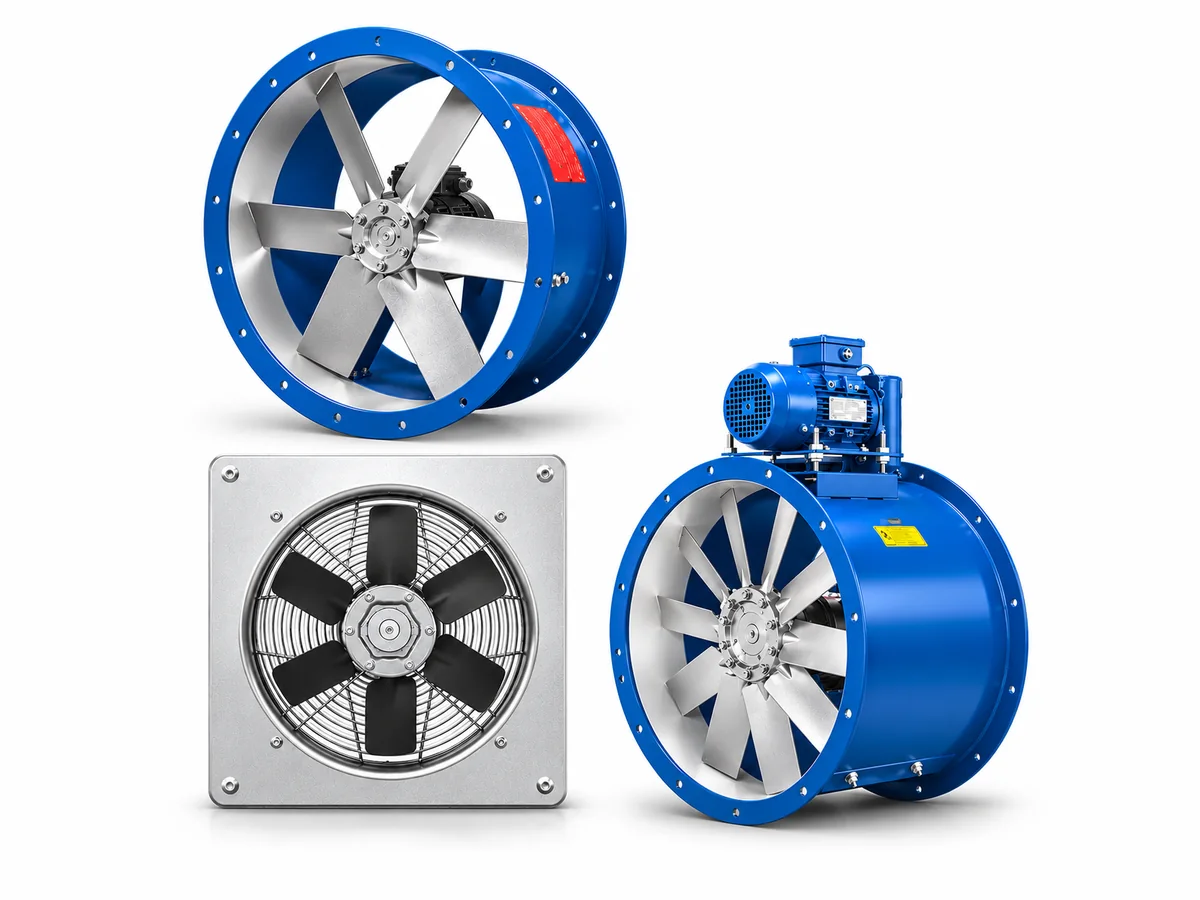
Three things work together. First, the motor is sealed or built so that any spark inside cannot get out. Second, the impeller and the casing are made from material pairs that do not spark if they touch, such as aluminium against steel with a safe gap. Third, the surface stays below a set temperature, so it cannot light the gas.
In Europe these fans are tested and marked under ATEX, and the fan design follows EN 14986. IECEx is the international scheme with the same zone system. Some projects ask for ATEX and others for IECEx, so always check what your consultant or client asks for.
Fuel vapour gathers near pumps, tanks and pump rooms. Any fan inside these areas must be rated for the zone.
Solvent fumes from spray painting in car workshops and factories are very easy to light. The booth exhaust fan must be explosion proof.
Lead acid batteries give off hydrogen while charging, for example in forklift charging bays, data centres and telecom rooms. Hydrogen needs fans rated for gas group IIC or marked for H2.
Stores with solvents, thinners or gas cylinders need safe extraction so vapours never build up.
Fine dust from flour, sugar, wood or metal can also explode. Fans for these areas are rated for dust zones.
Every certified fan carries a code on its nameplate. Here is an example and what each part means:
II 2G Ex db eb IIB T4 Gb
| Part | Meaning |
|---|---|
| II | For surface use, not underground mines |
| 2G | Category 2 for gas, safe for Zone 1 and Zone 2 |
| Ex db eb | Types of protection: flameproof motor box and increased safety terminals |
| IIB | Gas group. IIA is the easiest, such as propane. IIC is the hardest, such as hydrogen and acetylene |
| T4 | Temperature class. The surface stays below 135°C |
| Gb | Equipment protection level for Zone 1 |
The zone tells you how often the dangerous air is there. The owner or the safety engineer sets the zone for each area. The fan must match it.
| Gas zone | Dust zone | When the danger is there | Fan category |
|---|---|---|---|
| Zone 0 | Zone 20 | All the time or for long periods | 1 |
| Zone 1 | Zone 21 | Likely in normal work | 2 |
| Zone 2 | Zone 22 | Not likely, or only for a short time | 3 |
The temperature class must be safe for the gas in the area. T1 allows up to 450°C, T2 300°C, T3 200°C, T4 135°C, T5 100°C and T6 85°C. A lower number means a hotter surface is allowed, so a T4 fan is also safe where T3 is needed.
For paint booths, pump rooms and stores that blow straight outside through a wall.Industrial axial fans
For booths and rooms with a duct, filters or a long run to the roof.Centrifugal blowers
For tank cleaning, confined spaces and plant shutdowns, with a flexible hose.Portable exhaust fans
Zone, such as Zone 1 or Zone 2, or the dust zone
Gas or dust, or the gas group (IIA, IIB, IIC) and the temperature class
Airflow in m³/h or CFM, and the pressure if there is a duct
Fan type: wall, duct, roof or portable
Power supply, single or three phase, 60 Hz
Certificate needed: ATEX, IECEx or both
These fans cost more than normal fans of the same size, because of the special motor, materials and testing. The price depends on the zone, the gas group, the size and the certificate. Send us your details on WhatsApp for today's price.
Send us the zone, the gas or dust, the airflow and a photo of the area on WhatsApp. We will match a certified fan and reply with a clear price and the certificate. Visit our office at 8035 Al Adl Al Waez, Al Amal, Riyadh 12643, open 8:00 to 17:00, call +966 56 259 8137, or email sales@cloudventsa.com. We deliver across the Kingdom, including Riyadh, Jeddah, Dammam, Al Khobar, Makkah and Madinah.
No. The whole fan must be certified, not only the motor. A safe motor on a steel impeller that can spark against the casing is still a danger. Ask for the certificate for the complete fan.
Yes. A fan for Zone 1 (category 2) is also safe in Zone 2. The other way round is not allowed.
Batteries give off hydrogen, which is in gas group IIC. Choose a fan rated for IIC or marked for hydrogen (H2), and place the extract high in the room, because hydrogen rises.
Some sizes may be in stock, and others are made to order. Send us your details, and we will confirm the stock and delivery time with the price.
The owner of the site or its safety engineer classifies each area. Your consultant then lists the zone in the fan schedule. We match the fan to it.